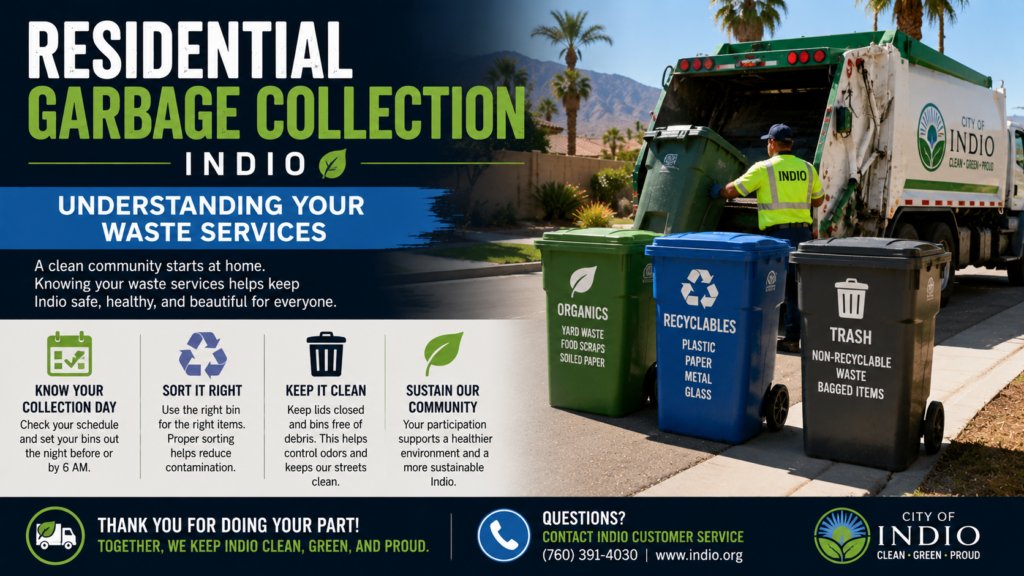
Residential Garbage Collection Indio is one of those essential services that most people think about only when something goes wrong a missed pickup, an overflowing bin, or a question about what can and cannot go in which container. In Indio, California, the residential waste management system operates within a structured framework governed by both city regulations and California state law. Understanding how the system works, what it covers, and what responsibilities homeowners have makes the system more useful and helps avoid common problems.
How Residential Garbage Collection Is Structured in Indio
The City of Indio coordinates solid waste and recycling collection services for its residential community. Collection is organized on a weekly schedule, with designated pickup days assigned based on neighborhood and address. Residents receive one collection service per week for each of their waste streams general garbage, recyclables, and green/organic waste.
California’s waste management infrastructure is shaped by significant state legislation. AB 939, the California Integrated Waste Management Act, requires municipalities to divert at least fifty percent of waste from landfills. More recently, SB 1383 California’s Greenhouse Gas Reduction Law targets methane emissions by requiring diversion of organic waste, including food scraps, yard trimmings, and certain paper products. These laws directly affect how residential waste collection is organized in Indio, driving the separation of organic materials into dedicated collection streams.
What Goes in Each Container
Most Indio residential properties receive service through a three-container system: a trash/garbage cart, a recycling cart, and an organics/yard waste cart. Understanding what belongs in each is both a practical and legal matter in California.
General garbage accepts non-recyclable, non-hazardous materials that don’t belong in the other streams. This includes non-recyclable plastics, soiled paper products, personal hygiene items, and other ordinary household waste.
Recycling accepts clean, dry recyclable materials paper and cardboard, glass bottles and jars, metal cans and containers, and plastic bottles and containers. Contamination of recycling with food waste, non-recyclable materials, or liquids reduces the value and usability of the recycled materials and can result in loads being rejected or sent to the landfill.
Organics/yard waste is the stream most directly affected by SB 1383. In Indio, as throughout California, food scraps including fruits, vegetables, meat, dairy, and food-soiled paper belong in this stream along with traditional yard trimmings like grass, leaves, and plant materials. This organics collection allows material to be processed into compost rather than decomposing in a landfill and generating methane.
Bulky Item Collection and Special Pickups
One of the most valued components of residential garbage service in Indio is the provision for bulky item disposal. Large items that don’t fit in standard carts furniture, appliances, mattresses, exercise equipment, and similar items can be disposed of through designated bulky item pickup programs. Indio provides these services to residential customers, allowing them to dispose of large items without hauling them to a disposal facility themselves.
Electronic waste computers, televisions, phones, batteries, and related electronics requires separate handling because it contains materials that are harmful if landfilled. Indio provides designated e-waste disposal options, keeping these materials out of the general waste stream and in channels where valuable materials can be recovered.
Household Hazardous Waste: What Cannot Go in Regular Collection
A significant category of household materials cannot be placed in residential garbage or recycling carts because they contain chemicals that are harmful to the environment or waste collection workers. These include paints and solvents, pesticides and herbicides, pool chemicals, motor oil and automotive fluids, batteries (other than alkaline), fluorescent bulbs, and cleaning products with hazardous components.
In Indio, household hazardous waste has specific disposal channels. Riverside County operates a permanent Household Hazardous Waste facility in Palm Springs, and the City of Indio partners with the City of Coachella to provide an ABOP (Antifreeze, Batteries, Oil, Filters, and Paint) drop-off collection center. These facilities accept specific materials and provide an environmentally responsible alternative to illegal dumping.
Placement and Timing Requirements
Residential garbage service in Indio operates under placement and timing requirements that residents should observe. Containers are to be placed at the curb on the designated service day and should not remain at curbside for more than 24 hours after collection. Containers placed too early or left out too long can violate city ordinances and create neighborhood aesthetic and safety concerns.
Containers should be positioned with lids fully closed to prevent wind scatter and wildlife access both practical concerns in Indio, where desert winds can spread loose materials and wildlife encounters around refuse are not uncommon in some neighborhoods. Containers require adequate clearance from vehicles, mailboxes, and other obstacles to allow collection vehicles to access them efficiently.
Holiday and Weather Disruptions
Collection schedules can be affected by recognized holidays. When a holiday falls during a service week, pickups are typically delayed by one day for that week and all subsequent days in the week. Residents should check with their service provider when holidays fall near their scheduled pickup day.
While significant weather events are less common in the Indio desert than in coastal or mountainous parts of California, high wind events can occasionally disrupt service. Wind events that create hazardous road conditions or excessive blowing debris may result in temporary service modifications.
The Environmental Significance of Residential Participation
Residential waste diversion the combined effect of individual households properly sorting and placing their waste has measurable environmental impacts. Organic material diverted from landfills reduces methane generation, a greenhouse gas with significantly higher warming potential than carbon dioxide. Recyclable materials kept out of the landfill and properly processed reduce the need for virgin raw material extraction. Each correctly sorted residential bin contributes to these outcomes at a community scale.
In Indio, a community committed to growth and quality of life in a desert environment, responsible waste management is part of a broader commitment to environmental stewardship. Understanding and participating in the residential collection system is one of the most concrete and immediate ways residents contribute to that commitment.